
Why Voice Search is the High-Stakes Frontier for US Businesses in 2026
Voice search optimization is the final piece of the puzzle for US business owners who feel like they are constantly chasing a moving target. Running a local business today often feels like a race that never ends; you’ve mastered social media, conquered email marketing, and just when you think you’re finally ahead, the technology shifts again. It’s deeply exhausting to know your “near me” customers are actively looking for you, yet their devices simply aren’t finding you.
If you’re tired of losing high-value leads to competitors just because their website communicates with Siri or Alexa better than yours does, you’re in the right place. This guide simplifies the transition to conversational search to ensure your business stays audible, visible, and profitable in 2026.
What is local voice search optimization?
In 2026, local voice search optimization is the process of tailoring your website’s content and technical structure to answer spoken queries from AI assistants. It focuses on natural language, long-tail conversational keywords, and up-to-date Google Business Profile data to ensure your US-based business appears in “near me” results and AI-generated overviews.

Why Voice Search is Non-Negotiable in 2026
The era of typing three-word phrases into a search bar is fading. With the rise of advanced AI agents, US consumers are now having full-blown conversations with their devices. Whether they are driving through traffic or cooking dinner, they are asking, “Where is the best-rated plumber open now?” If your site isn’t built for these conversational shifts, you’re essentially invisible to a massive segment of the market.
How do I optimize my local business for AI voice search?
To optimize for AI voice search, you must prioritize “Natural Language Processing” (NLP). This involves creating FAQ sections that mirror how people actually speak and ensuring your Schema Markup is error-free. By providing direct, conversational answers to specific local questions, you increase the likelihood of being the “featured snippet” that AI assistants read aloud to users.
The Role of Google Business Profile in Local Results
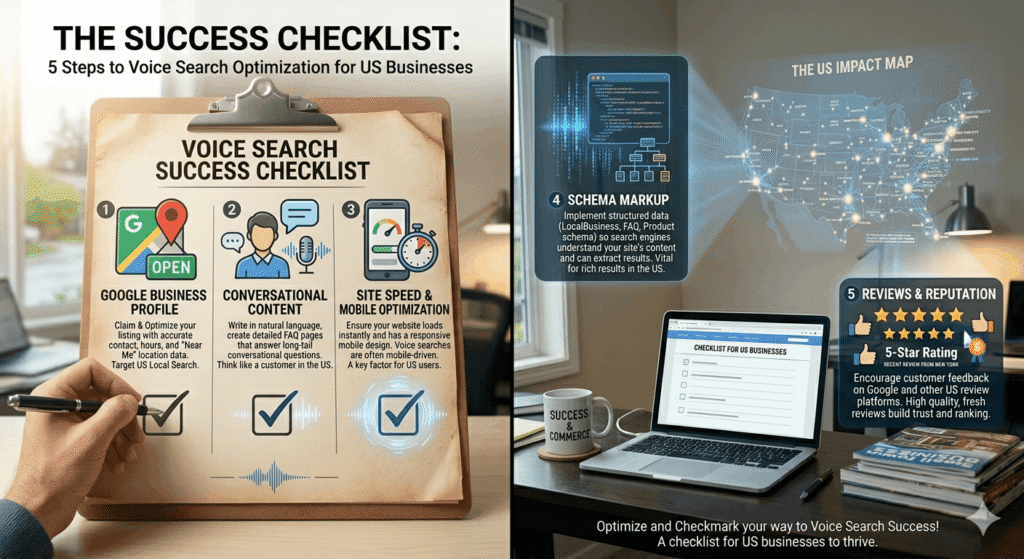
For any US business, your Google Business Profile (GBP) is the heartbeat of your local presence. When someone asks a voice assistant for a service “near me,” the AI pulls data directly from GBP.
- Accuracy: Ensure your Name, Address, and Phone number (NAP) are identical across the web.
- Attributes: Use specific tags like “women-owned,” “wheelchair accessible,” or “free Wi-Fi.”
- Reviews: High-velocity, positive reviews signal to AI that you are a trusted local authority.
How to Get Your Small Business to the Top of Google Search in Your City remains the foundation for these efforts, as voice search is essentially an extension of a strong pillar SEO strategy.
What are the best keywords for voice search optimization in the US?
The best keywords for voice search optimization in US markets are long-tail, question-based phrases. Instead of “pizza Chicago,” optimize for “where can I find the best thin-crust pizza in downtown Chicago?” Focus on “who,” “what,” “where,” and “how” questions that local customers frequently ask during their buying journey.
Technical Requirements: Speed and Mobile-First
Voice searches happen almost exclusively on mobile devices or smart speakers. If your website takes more than two seconds to load, the AI assistant will likely skip over you in favor of a faster competitor.
- Mobile Responsiveness: Your site must look and function perfectly on all screen sizes.
- Schema Markup: Use “LocalBusiness” structured data to tell search engines exactly what you do and where you are.
How does AI voice search optimization differ from traditional SEO?
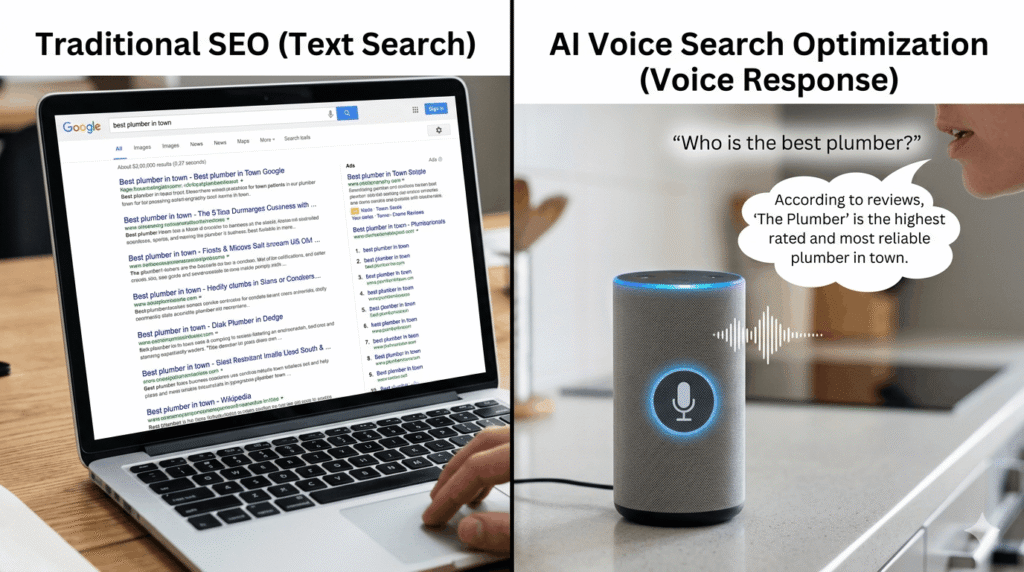
Traditional SEO often focuses on short, high-volume keywords, whereas AI voice search optimization prioritizes intent and context. AI models in 2026 look for “entities” and the relationship between topics rather than just keyword density. It requires a more holistic approach to content that provides immediate value and solves specific user problems in a conversational tone.

Staying Ahead of the Curve
As we look at Digital Advertising Trends Shaping US Small Businesses in 2026, it’s clear that voice is becoming the primary interface for the “on-the-go” consumer. Integrating your voice strategy with your broader digital advertising ensures a seamless experience for your customers.
Is voice search optimization near me still relevant for 2026?
Yes, voice search optimization near me is more relevant than ever because AI assistants have become highly localized. Users now expect their devices to know their exact location and provide real-time solutions. Businesses that use hyper-local geo-tagging and mention specific neighborhood landmarks in their content will dominate these “near me” voice queries.
Partner with Talatech for Voice Search Mastery
Navigating the complexities of voice search optimization doesn’t have to be a solo journey. At Talatech, we specialize in helping US businesses bridge the gap between traditional search and the AI-driven future. As a Google-certified partner, our team understands the nuances of the US market and the technical rigor required to rank.
We offer:
- Full Voice Search Audits
- Localized Content Creation
- Advanced Schema Implementation
- 24/7 Availability for our partners.
Stop being the best-kept secret in your city. Call Talatech now +1 (940) 597-5872 or visit our contact page to schedule your local SEO consultation. Let’s make sure when your customers talk, the AI mentions your name.
FAQs about Voice Search Optimization in the US
To help you dominate your local market in 2026, here are the most common questions US business owners ask about staying visible in a voice-first world.
How do I optimize my local business for AI voice search?
To optimize for AI voice search, you must prioritize Natural Language Processing (NLP). This involves creating FAQ sections that mirror how people actually speak and ensuring your Schema Markup is error-free. By providing direct, conversational answers to specific local questions, you increase the likelihood of being the “featured snippet” that AI assistants read aloud to users.
What are the best keywords for voice search optimization in the US?
The best keywords for voice search optimization in US markets are long-tail, question-based phrases. Instead of “pizza Chicago,” optimize for “where can I find the best thin-crust pizza in downtown Chicago?” Focus on “who,” “what,” “where,” and “how” questions that local customers frequently ask during their buying journey.
How does AI voice search optimization differ from traditional SEO?
Traditional SEO often focuses on short, high-volume keywords, whereas AI voice search optimization prioritizes intent and context. AI models in 2026 look for “entities” and the relationship between topics rather than just keyword density. It requires a more holistic approach to content that provides immediate value and solves specific user problems in a conversational tone.
Is voice search optimization near me still relevant for 2026?
Yes, voice search optimization near me is more relevant than ever because AI assistants have become highly localized. Users now expect their devices to know their exact location and provide real-time solutions. Businesses that use hyper-local geo-tagging and mention specific neighborhood landmarks in their content will dominate these “near me” voice queries.
Does my website speed affect voice search results?
Absolutely. Voice assistants prioritize the fastest “best” answer. If your mobile site takes too long to load, the AI agent will move to the next available source to provide the user with a seamless experience.
How does my Google Business Profile impact voice search?
Your Google Business Profile is the primary data source for voice searches like “find a [service] near me.” If your profile is incomplete, has incorrect hours, or lacks recent reviews, AI assistants are less likely to recommend your business to local searchers.