
The SBA 7-8% Benchmark: Defining Your 2026 Digital Ad Spend
You’re running your business, serving customers, and somewhere between payroll and invoices you’re also supposed to figure out your digital advertising budget for small business with no clear answer in sight. Sound familiar?
Most US small business owners aren’t failing at marketing because they lack effort. They’re failing because they’re spending money without a framework. They boost a Facebook post here, try a Google Ad there, and wonder why the phone isn’t ringing any louder. This post changes that.
By the end of this guide, you’ll know exactly how much to allocate to digital advertising, how to split that budget across channels, and how to measure whether every dollar is pulling its weight.
Table of Contents
How Much Should a Small Business Spend on Digital Advertising?
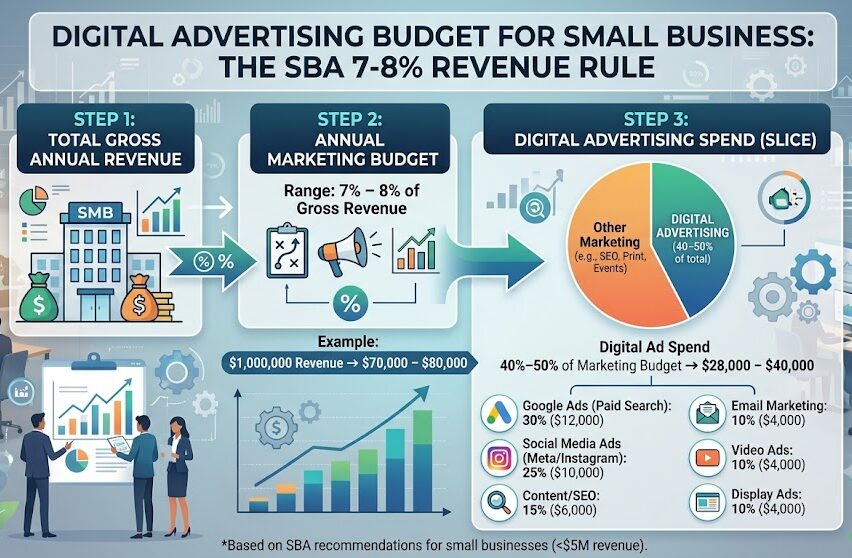
The US Small Business Administration recommends allocating 7–8% of gross revenue to marketing for businesses under $5M in revenue. Of that, 40–50% is typically allocated to digital advertising.
In practice, that means a business earning $250,000/year should budget roughly $17,500–$20,000 for total marketing and $7,875–$9,000 of that toward digital ads. For businesses in competitive markets or in a growth phase, spending at the higher end (or even up to 10–12%) is common and often necessary.
Sources: US Small Business Administration, eMarketer, HubSpot Marketing Benchmarks
What Is the Right Digital Advertising Budget for a Small Business?
The right digital advertising budget for small business isn’t a single dollar amount, it’s a formula tied to your revenue, industry, and growth goals. The SBA’s 7–8% rule is the most widely cited starting point, but how you allocate within that budget is where real strategy begins.
Here’s a practical breakdown by annual revenue using the SBA benchmark plus a 45% digital allocation:
| Revenue Range | Recommended Marketing Budget (7–8%) | Digital Ad Spend (45% of budget) |
| $100,000/year | $7,000–$8,000/year | $3,150–$3,600/year (~$263–$300/mo) |
| $250,000/year | $17,500–$20,000/year | $7,875–$9,000/year (~$656–$750/mo) |
| $500,000/year | $35,000–$40,000/year | $15,750–$18,000/year (~$1,313–$1,500/mo) |
| $1,000,000/year | $70,000–$80,000/year | $31,500–$36,000/year (~$2,625–$3,000/mo) |
| $5,000,000/year | $350,000–$400,000/year | $157,500–$180,000/year (~$13,125–$15,000/mo) |
These are starting benchmarks. Highly competitive industries, legal, dental, home services often see small businesses spend closer to 10–15% of revenue on marketing according to WordStream‘s PPC benchmarks and eMarketer‘s US ad spend forecasts.
Industry Adjustments to Keep in Mind
- Service businesses (plumbers, electricians, lawyers): Spend more 8–12%. Local competition is fierce and search intent is immediate.
- Retail/eCommerce: Budget 10–15%. You’re competing nationally even if you serve locally.
- B2B professional services: 5–8% is typical. Longer sales cycles mean content and search matter more than display.
- Restaurants and food service: 3–6%. Social and Google My Business optimization often outperforms paid ads here.
How Should a Small Business Allocate Its Digital Advertising Budget Across Channels?
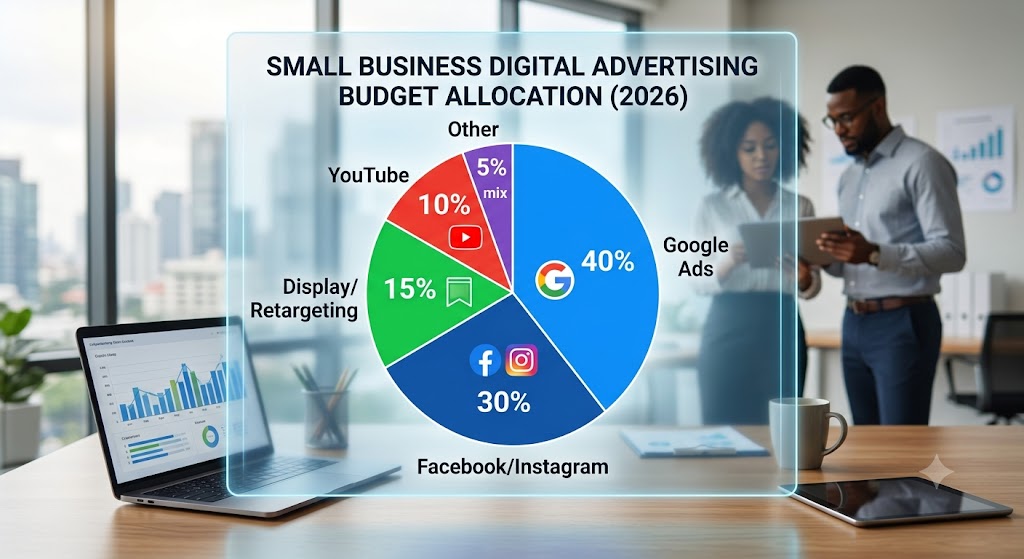
Once you know your total digital advertising budget for small business, the next challenge is channel allocation. Not every platform delivers the same return, and the right mix depends on your business type, target audience, and sales cycle.
Recommended Channel Split for Most US Small Businesses
- Google Search Ads (35–45%): Captures high-intent buyers actively searching for your service. For local businesses, this is typically the highest-ROI channel. Our Google Ads for Small Business guide walks through how to set up your first campaign without waste.
- Social Media Ads — Facebook/Instagram (25–35%): Best for awareness, remarketing, and reaching audiences who don’t yet know they need you. See our full Facebook Ads for Small Business guide for a step-by-step beginner setup.
- Display/Retargeting (10–15%): Lower-cost impressions to keep your brand visible to website visitors who didn’t convert.
- YouTube/Video Ads (5–10%): Growing in effectiveness for local businesses; especially effective for service demonstrations.
- Other (SEO tools, email, content promotion) (5–10%): Supports long-term organic growth alongside paid campaigns.
According to Nielsen‘s cross-channel research, brands that diversify across at least three channels see up to 23% better performance than single-channel advertisers, even at the same spend level.
How Much Should a Small Business Spend on Google Ads?
According to the Google Ads Benchmark Report, the average small business spends between $1,000 and $10,000 per month on Google Ads, with significant variation by industry. WordStream data shows the average cost per click (CPC) across industries ranges from $1 to $8 for the search network but legal, financial, and insurance categories can exceed $50 per click.
For most US local businesses just starting out, a monthly Google Ads budget of $500–$1,500 is enough to generate meaningful data and consistent leads, provided the campaigns are properly structured.
For a deeper look at getting started, visit our guide: Google Ads for Small Business: How to Run Your First Campaign Without Wasting Money.
PPC Budget Calculator: Quick Estimate
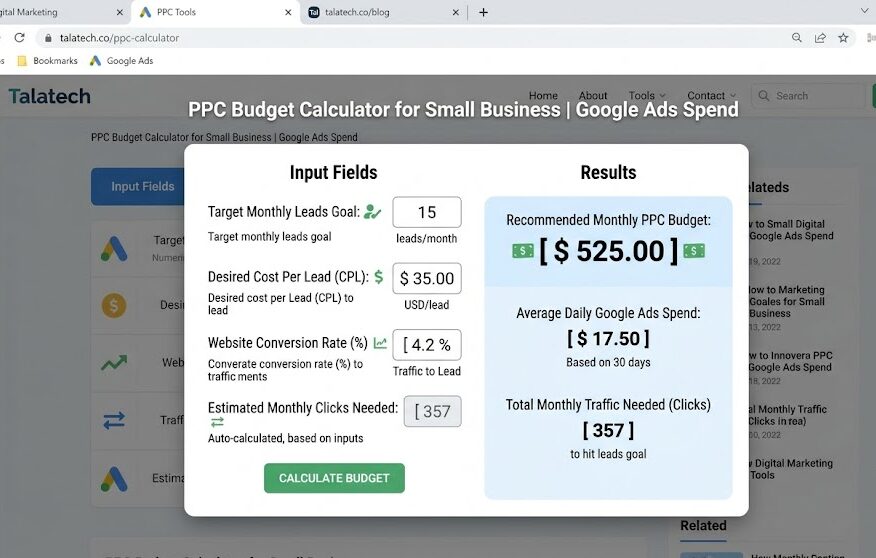
Use this formula to estimate your monthly Google Ads budget:
Monthly Budget = (Target Monthly Leads × Cost Per Lead Goal) ÷ Expected Conversion Rate
Example: You want 20 leads/month. Your target cost per lead is $50. Industry average conversion rate on Google Ads for your niche is 5%.
Monthly clicks needed = 20 ÷ 0.05 = 400 clicks
Budget = 400 clicks × average CPC of $3.50 = $1,400/month
What Digital Ad Spend Benchmarks Should Small Businesses Use?
Knowing the right digital ad spend benchmarks helps you assess whether your investment is competitive. Here are the most reliable data points from industry sources US small businesses should track:
| Benchmark Metric | Industry Average | Source |
| Average Google Ads CPC (all industries) | $2.69 (Search) | Google Ads Benchmark Report |
| Average Facebook Ads CPC | $0.97 | WordStream |
| Average conversion rate (Google Ads) | 3.75% (search) | WordStream |
| SMB monthly digital ad spend | $1,000–$10,000 | eMarketer |
| Marketing budget as % of revenue (under $5M) | 7–8% | US Small Business Administration |
| Email marketing ROI | $36 for every $1 spent | HubSpot Marketing Benchmarks |
These benchmarks matter because they give you a reality check. If your cost per click is double the industry average, something is structurally wrong with your campaigns and no budget increase will fix poor targeting. As Forbes notes, small businesses that track and benchmark their ad performance are significantly more likely to achieve positive ROI within 90 days of campaign launch.
For a full strategic framework, explore our Paid Digital Advertising Guide for US Small Businesses.
When Should a Small Business Increase Its Digital Advertising Budget?
Knowing when to scale up your digital advertising budget for small business is just as important as knowing where to start. Increasing budget without evidence is waste. Increasing budget with the right signals is growth acceleration.
5 Signs You’re Ready to Scale Your Ad Budget
- Your cost per lead is at or below your target. Pouring more money into a profitable campaign accelerates returns.
- Your campaigns are running out of budget before the day ends. That’s money left on the table.
- Your organic search is strong but competitors are dominating paid placements for your best keywords.
- Seasonal demand is approaching (holiday season, spring home improvement rush, back-to-school).
- You’ve launched a new service or location and need to build awareness fast.
Signs You Should Pause — Not Increase — Your Budget
- Your click-through rate (CTR) is below 1% on search ads. This signals a keyword/ad copy mismatch.
- Your landing page conversion rate is below 2%. More traffic won’t fix a broken landing page.
- You can’t track which ads are generating leads. Budget increases require attribution clarity first.
HubSpot Marketing Benchmarks data consistently shows that businesses with clear attribution models outperform their competitors in ad ROI by 30% regardless of spend level.
How Do You Track Whether Your Digital Advertising Budget Is Working?
Setting a digital advertising budget for small business without tracking is like filling up your car without checking whether you’re actually moving. The good news: the core metrics aren’t complicated.
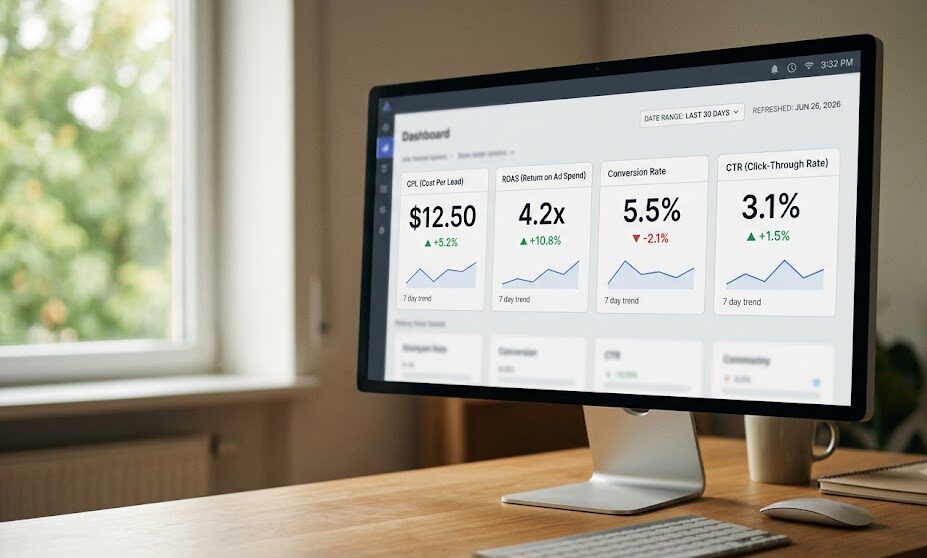
The 4 Metrics Every Small Business Must Track
- Cost Per Lead (CPL): Total ad spend ÷ number of leads generated. Target varies by industry; for local services, $20–$80 is typical according to WordStream.
- Return on Ad Spend (ROAS): Revenue generated ÷ ad spend. A ROAS of 3:1 (you earn $3 for every $1 spent) is the general break-even threshold for most service businesses.
- Conversion Rate: The % of ad clicks that turn into a lead or sale. Google Ads Benchmark Report data shows the US average is 3.75% for search and 0.77% for display.
- Click-Through Rate (CTR): The % of impressions that result in a click. For Google Search Ads, a 4–6% CTR is considered healthy for local keywords.
Setting Up Attribution
Before you increase your digital advertising budget, make sure you have Google Analytics 4, Google Ads conversion tracking, and Facebook Pixel all correctly installed. Without these, you’re reporting on impressions and clicks — not on revenue. eMarketer research shows that SMBs with proper attribution run 22% more efficient campaigns than those without it.
Small Business Marketing Budget vs. Digital Advertising Budget: What’s the Difference?
Many small business owners use these terms interchangeably, but they’re not the same thing and conflating them leads to real budget mistakes.
- Marketing budget: The total investment in all marketing activities, branding, website, SEO, email, events, print, and digital ads.
- Digital advertising budget: The specific slice of your marketing budget dedicated to paid digital channels, Google Ads, Meta Ads, YouTube, display, and retargeting.
For a $250,000/year business: Total marketing budget might be $18,000/year. Of that, $8,100 (45%) is the digital advertising budget. The remaining $9,900 covers SEO, website maintenance, content creation, and local sponsorships.
Getting this distinction right lets you evaluate each component of your marketing mix on its own merits and make smarter reallocation decisions as you grow.
Ready to Build a Digital Advertising Budget That Actually Works? Talatech Can Help.
Setting the right digital advertising budget for small business is only half the battle. Knowing how to deploy it across the right channels, with the right targeting, and with proper tracking in place is what separates businesses that grow from those that burn through their marketing spend.
Talatech is a US-based local SEO and digital advertising agency built specifically for small businesses. We don’t do one-size-fits-all. We build custom paid advertising strategies grounded in your revenue goals, competitive landscape, and market.
Why US Small Businesses Choose Talatech:
- Certified Google Ads and Meta Ads specialists
- Transparent reporting, you see exactly where every dollar goes
- Full-funnel strategy: search, social, retargeting, and landing page optimization
- Serving small businesses across the US, no long-term lock-in contracts
- Available for a free 30-minute budget audit, we’ll review your current spend and tell you exactly what’s working and what isn’t
Stop guessing. Contact Talatech today for a free digital advertising budget consultation or call us directly (940) 597-5872 to speak with a strategist about your 2026 ad plan.
Frequently Asked Questions: Digital Advertising Budget for Small Business
How much should a small business spend on digital advertising per month?
Most US small businesses spend between $500 and $5,000 per month on digital advertising. The SBA-aligned benchmark is 7–8% of annual gross revenue allocated to total marketing, with roughly 45% of that going to paid digital. For a $500,000/year business, that’s approximately $1,300–$1,500/month in digital ad spend.
What is a good ROAS for a small business?
A 3:1 ROAS (earning $3 for every $1 spent) is generally the break-even threshold for most service businesses. For eCommerce, a 4:1 ROAS is the standard minimum. Some highly efficient campaigns achieve 8:1 or higher but that typically requires significant optimization over time.
Is $500/month enough for Google Ads?
Yes, for many local service businesses, $500–$1,000/month on Google Ads is enough to generate consistent leads if the campaigns are properly structured and targeted. The key is tight geographic targeting, strong ad copy, and a high-converting landing page. A $500 budget spread too thin across irrelevant keywords won’t deliver results.
What percentage of small business revenue goes to advertising?
The US Small Business Administration recommends 7–8% of gross revenue for businesses under $5M. Of that, approximately 40–50% typically goes to digital advertising. Businesses in high-competition industries (legal, healthcare, home services) often spend 10–15%.
How do I calculate my small business marketing budget?
Start with the SBA formula: multiply your annual gross revenue by 0.07 to 0.08. That’s your total marketing budget. Then allocate 40–50% of that to digital advertising. Break the digital budget down by channel based on your target audience: Google Ads for high-intent searchers, Facebook/Instagram for awareness and remarketing, and retargeting to recapture website visitors.
Should a new small business spend more on advertising?
Yes. New businesses without an established customer base or organic presence typically need to invest more aggressively, closer to 12–15% of projected revenue in the first 1–2 years. The goal is to build awareness and initial customer acquisition quickly enough to hit sustainable revenue before reducing spend.
Available Mon-Fri / 9am-5pm EST | (940) 597-5872 | Contact Us Online | Google Business Profile