
Moving Beyond Vanity Metrics: How Clean Data Protects Your Budget
Every dollar you pour into advertising should feel like an investment, not a gamble. Yet, for many US business owners, launching a new campaign feels like throwing money into a black box and hoping for the best. It is incredibly frustrating to watch your hard-earned capital leave your bank account without knowing exactly which channels are driving growth and which are completely stalling. If you are tired of guessing where your sales are coming from, you are in the right place. This comprehensive guide will show you exactly how to track marketing ROI, break down the tools that make it simple, and reveal the metrics that actually matter to your bottom line.
Table of Contents
Marketing ROI (Return on Investment) is a measurement of how much revenue your marketing efforts generate relative to what you spend. To track it accurately, businesses calculate the net profit of a campaign, divide it by the total marketing cost, and multiply by 100.
The following table ranks the 10 essential marketing ROI metrics and tracking tools by their usefulness for US small business owners:
| Rank | Metric / Tool Name | Type | Primary Use Case | Usefulness Score (1-10) |
| 1 | Google Analytics 4 | Tool | Tracking website conversions and traffic sources | 10/10 |
| 2 | Customer Acquisition Cost (CAC) | Metric | Measuring the total cost to win a new customer | 9.5/10 |
| 3 | Customer Lifetime Value (CLV) | Metric | Predicting total revenue from a single customer | 9.5/10 |
| 4 | HubSpot | Tool | All-in-one CRM and inbound lead tracking | 9/10 |
| 5 | Google Ads Manager | Tool | Measuring paid search campaign performance | 9/10 |
| 6 | Conversion Rate (CR) | Metric | Percentage of visitors taking a desired action | 8.5/10 |
| 7 | Meta Ads Manager | Tool | Tracking paid social media return and ROAS | 8.5/10 |
| 8 | UTM Parameters | Method | Tracking exact link clicks and campaign origins | 8/10 |
| 9 | Databox | Tool | Consolidating multi-channel marketing KPIs | 7.5/10 |
| 10 | Looker Studio | Tool | Creating visual ROI dashboards for clients | 7/10 |

What is a good marketing ROI for a small business?
A good marketing ROI for most small businesses is a 5:1 ratio, meaning you generate $5 in revenue for every $1 spent. A 10:1 ratio is considered exceptional, while a 2:1 ratio means the campaign is barely breaking even after accounting for production costs and overhead.
How do you calculate marketing ROI?
To calculate marketing ROI, deduct your total marketing expenses from your gross profit generated by marketing, divide that number by your marketing expenses, and multiply by 100. The standard marketing ROI formula is written as:

Which tools are best for tracking marketing ROI?
The best tools for tracking marketing performance include Google Analytics 4 for website traffic and conversion tracking, HubSpot for closed-loop customer relationship management, and Meta Ads Manager combined with Google Ads for paid campaigns. For consolidated visual reporting, Databox and Looker Studio are highly effective.
What metrics should I track to measure marketing performance?
To fully understand your returns, you must track key marketing KPIs such as Customer Acquisition Cost (CAC), Customer Lifetime Value (CLV), Return on Ad Spend (ROAS), and overall conversion rates. Monitoring these data points ensures you see both immediate revenue and long-term customer value.
The Strategic Importance of Tracking Marketing Performance
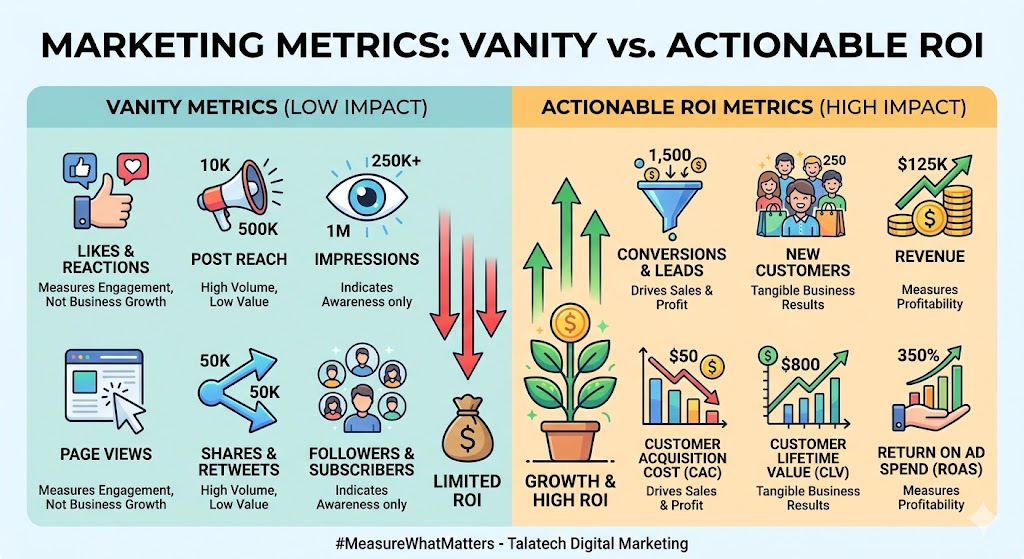
If you don’t know your numbers, you don’t know your business. Learning how to track marketing ROI is the baseline requirement for scaling any company in the competitive US market. Without clean data, you run the risk of cutting budgets for campaigns that are quietly generating high-value leads, or worse, doubling down on vanity metrics like “likes” or “impressions” that never convert into actual revenue.
To build an efficient marketing machine, you need to rely on clear frameworks. Implementing a robust Content Marketing Strategy: 9 Powerful Small Business Tips helps ground your organic efforts, but tracking ensures those pieces of content are pulling their financial weight.
The Danger of Vanity Metrics
It’s easy to get distracted by a spike in website traffic or social media followers. However, if that traffic doesn’t translate into sales or qualified leads, your investment isn’t working. True business growth relies on hard financial data, not surface-level engagement.
Essential Marketing ROI Metrics to Watch
To truly master how to track marketing ROI, you have to look beyond basic sales figures. You need a mix of operational and financial marketing ROI metrics to get a complete picture of your health.
1. Customer Acquisition Cost (CAC)
CAC calculates exactly how much your business spends to acquire a single new customer. To find this, divide your total marketing and sales costs over a specific period by the number of new customers acquired during that same window.
2. Customer Lifetime Value (CLV)
CLV represents the total net profit your business expects to earn from a single customer account over the lifetime of your relationship. If your CLV is significantly higher than your CAC, your marketing funnel is structurally sound.
3. Return on Ad Spend (ROAS)
While ROI looks at overall net profit relative to total spend, ROAS isolates your specific advertising campaigns. It answers a simple question: for every dollar spent on Google Ads or Meta Ads Manager, how much gross revenue did you bring back?
Advanced Marketing Analytics Tools and Methods
Manually crunching numbers in spreadsheets is a recipe for human error. Modern business owners rely on advanced marketing analytics tools to automate data collection and ensure perfect accuracy.
Setting Up Conversion Tracking
Before launching any digital campaign, you must establish proper conversion tracking. This involves placing tracking pixels from Google and Meta on your website so their algorithms can report exactly when a user makes a purchase, fills out a contact form, or calls your office.
[User Clicks Link with UTMs] ➔ [Enters Marketing Funnel] ➔ [GA4/HubSpot Records Conversion]
The Power of Attribution Modeling
Attribution modeling determines which touchpoints get credit for a sale. Did the customer buy because of their first search on Google, or because of a retargeting ad they saw on social media a week later? Using Google Analytics 4 allows you to choose data-driven attribution models, giving you a realistic look at the entire buyer’s journey.
To turn this traffic into paying clients, explore our comprehensive guide on Digital Marketing Lead Generation: A Complete Guide for US Business Owners to optimize your customer touchpoints.
Using UTM Parameters for Granular Tracking
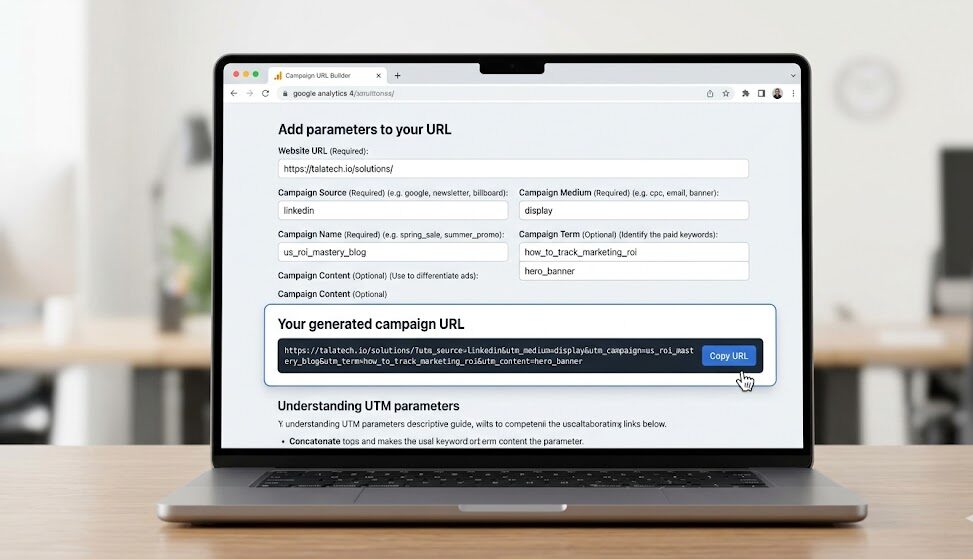
UTM parameters are short text codes added to the end of URLs. When a user clicks a link with these parameters, tools like Google Analytics 4 read the tags and show you exactly which specific email, social post, or ad variation drove the visit.
Implementing a Data-Driven Content and Advertising Routine
Tracking is not a one-time setup task; it requires a repeatable process. You should review your data on a weekly and monthly cadence to spot trends, run A/B testing on your landing pages, and adjust your budget allocations dynamically.
By constantly refining your campaigns based on hard numbers, you can easily implement the Best Lead Generation Strategies for 2026 without wasting capital on unproven concepts. This systematic approach eliminates the guesswork from your business growth.
Partner with Talatech to Maximize Your Marketing ROI
stop wondering whether your marketing budget is actually working for you. At Talatech, we specialize in taking the guesswork out of digital growth for small business owners across the US. As a fully certified digital agency holding Google Analytics 4 Certification and HubSpot Inbound Marketing Certification, our team builds transparent, high-converting marketing structures designed specifically to maximize your revenue.
We are currently accepting new business clients for comprehensive marketing audits and data-tracking overhauls. Let us help you identify exactly where your leaks are and implement a bulletproof strategy to fix them.
Ready to see true return on your investment?
📞 Call us now (940) 597-5872 or Contact us here to directly to schedule your custom marketing ROI consultation.
Frequently Asked Questions (FAQ)
How do I track ROI from social media marketing?
To track social media ROI, use unique UTM parameters on every link you post, and set up custom conversion events inside Meta Ads Manager or Google Analytics 4. This links specific social posts or ad sets directly to revenue-generating actions like form fills or purchases.
How often should I review my marketing ROI?
You should review your tactical campaign metrics weekly to optimize active ad spend, while broader key marketing KPIs and overall business ROI should be thoroughly analyzed at the end of every month and quarter.
Can small businesses track marketing ROI without expensive tools?
Yes. Small businesses can track their returns effectively using entirely free tools like Google Analytics 4 paired with Looker Studio for visual reporting, and basic built-in CRM platforms to follow leads to conversion.
Available Mon-Fri / 9am-5pm EST | (940) 597-5872 | Contact Us Online | Google Business Profile